



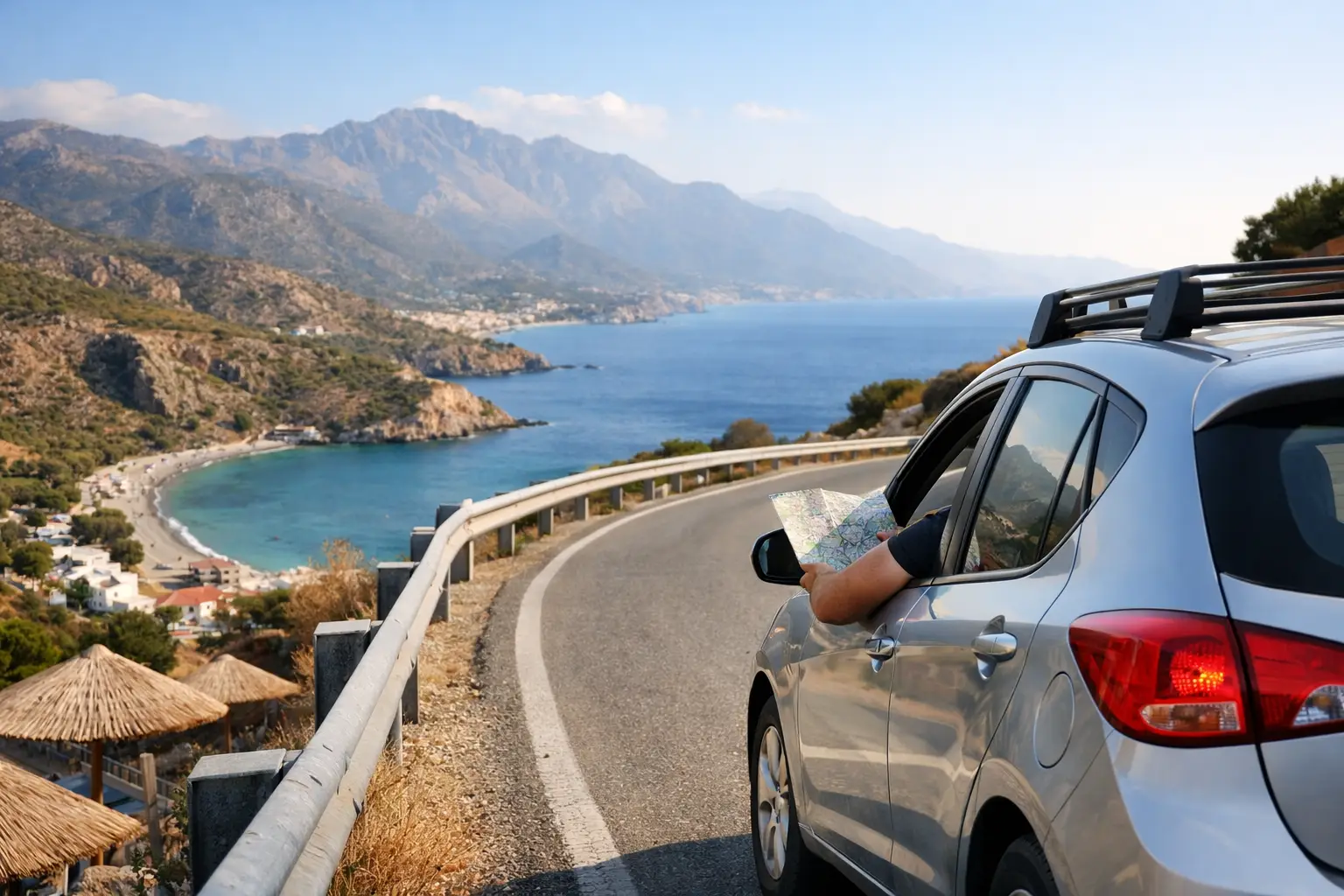


The difference between a rushed Crete holiday and a relaxed one often comes down to a simple question – how easily can you move around? Touring Crete by car gives you control over your schedule, your comfort and the places you can realistically reach in a day. On an island where quiet villages, coastal roads, mountain routes and resort towns all sit within driving distance of one another, that flexibility matters.
Crete is large by Greek island standards, and distances can be deceptive. A route that looks short on a map may involve winding roads, hill climbs or slower stretches through towns. Public transport works for some popular points, but it does not always match the pace or freedom most travellers want, especially if you are arriving with luggage, travelling as a family or planning to see more than one base during your stay.
Table of Contents
Why touring Crete works best with your own car
A car changes the rhythm of the trip. You are not planning your day around bus timetables or paying repeatedly for taxis between airport, hotel, beach and dinner reservation. You can leave early for a quieter swim, stop at a roadside taverna that catches your eye, or return to your hotel without watching the clock.
That matters even more if you are staying in places such as Heraklion, Hersonissos or Agios Nikolaos and want to combine resort time with day trips. A well-chosen hire car turns those places into convenient bases rather than limiting points on the map. You can spend one day on the north coast, another inland among traditional villages, and another following the eastern shoreline at your own pace.
There is also the comfort factor. Travelling with children, beach bags or shopping is far easier when everything stays with you. If your holiday is meant to feel easy, a clean, modern car with air conditioning and space for your group is not a luxury add-on. It is often the practical choice.
Choosing the right car for touring Crete
Not every trip needs the same vehicle, and this is where many travellers either overspend or make life harder than necessary. The best choice depends on your route, your group size and how you like to travel.
For couples staying in a resort town and making light day trips, a small city car is often ideal. It is easier to park, economical on fuel and perfectly suited to the island’s busier towns. If you are planning longer days on the road or want a little more comfort, a family car gives you better luggage space and a more relaxed drive.
SUVs are a strong option for travellers who want extra room, a higher driving position and comfort on mixed road conditions. They do not turn mountain roads into motorways, but they can make longer touring days feel less tiring. For larger families or friend groups, a minibus keeps everyone together and usually works out better than splitting into multiple vehicles.
Hybrid and electric models can also make sense, particularly for travellers who value quieter driving and lower fuel costs. The trade-off is planning. If you choose electric, you need to be realistic about charging access along your route rather than assuming it will be equally convenient everywhere.
Planning a smarter route when touring Crete
The mistake many visitors make is trying to cover too much ground too quickly. Crete rewards a measured approach. Rather than treating the island as a checklist, it is better to build days around regions.
If you arrive in Heraklion, for example, your first day may be best kept local. Settle in, collect your car, and keep the drive simple while you get used to the roads. The next day can stretch further, perhaps towards the east where resort areas, beaches and easy coastal driving make for a gentle introduction.
When touring Crete for a week or more, think in clusters. Spend one or two days around your base, one day inland, and another on a longer coastal route. This gives you enough freedom to see variety without spending the holiday constantly packing, checking maps and watching fuel levels.
It is also wise to build in slack time. A beach stop may last longer than planned. A village lunch may become the highlight of the day. Good touring on Crete is not about squeezing in the maximum number of kilometres. It is about having the freedom to follow the island’s slower, more enjoyable pace.
What the roads are really like
Crete is straightforward to drive in once you adjust your expectations. Main roads connecting major towns are generally manageable, while smaller roads can be narrower, more winding and slower than visitors first expect. In summer, popular resort areas can also become busier, especially around midday and early evening.
The key is to drive with patience. You are on holiday, not on a timetable. Allow more time than the map suggests, particularly if your route crosses mountainous areas or includes village roads. Local drivers may appear more confident on bends and narrower stretches, so it is best to keep your pace comfortable and let the drive remain enjoyable.
Parking also varies by location. Town centres and busy beach areas can be tighter, while hotels and less central areas are usually easier. This is another reason vehicle size matters. A car that suits your actual plans will always feel more premium than one that is unnecessarily large.
Airport, hotel and resort delivery make a difference
For many travellers, the most stressful part of hiring a car is not the driving. It is the pickup process. Queues, uncertainty and substitute vehicles can drain time and energy from the first day of a holiday.
That is why direct delivery matters. Having your vehicle arranged at the airport, port, hotel or resort area means you start the trip with clarity. You know what you are driving, where you are collecting it and how quickly you can be on your way. For a premium travel experience, this is not a small operational detail. It shapes the entire tone of the holiday.
A provider such as Autochoice fits particularly well here because the service is built around exact vehicle selection, local support and convenient handover points across Crete. For travellers who value certainty, that removes one of the most common points of friction from the journey.
What to check before you book
Price matters, but value matters more. A low headline rate can look appealing until you realise the terms are restrictive or unclear. Before booking, check what is included and whether the rental actually fits the way you plan to travel.
Unlimited kilometres are useful if you expect to move around frequently rather than stay close to one town. Insurance options should be clear, not buried in technical wording. Roadside assistance is worth having for peace of mind, even if you never need it. Free cancellation is also helpful if your flights or accommodation plans shift.
The other key point is vehicle certainty. Many travellers assume that booking a category means booking a specific model, then discover at collection that this is not the case. If the type of vehicle matters to your comfort, luggage space or travel style, make sure that what you book is what you will receive.
Touring Crete well means leaving room for ease
There is a tendency to over-plan island holidays, especially when Crete offers so much. But the best days on the road are usually the ones with enough structure to feel easy and enough freedom to feel personal. A good car, the right pickup arrangement and realistic route planning do more for your trip than a packed itinerary ever will.
Whether you are travelling as a couple, arriving with children, or coordinating a larger group, the real benefit of touring Crete is not simply seeing more. It is seeing the island in comfort, on your terms, without unnecessary pressure. Choose well, drive calmly, and let the road give your holiday a better shape.