



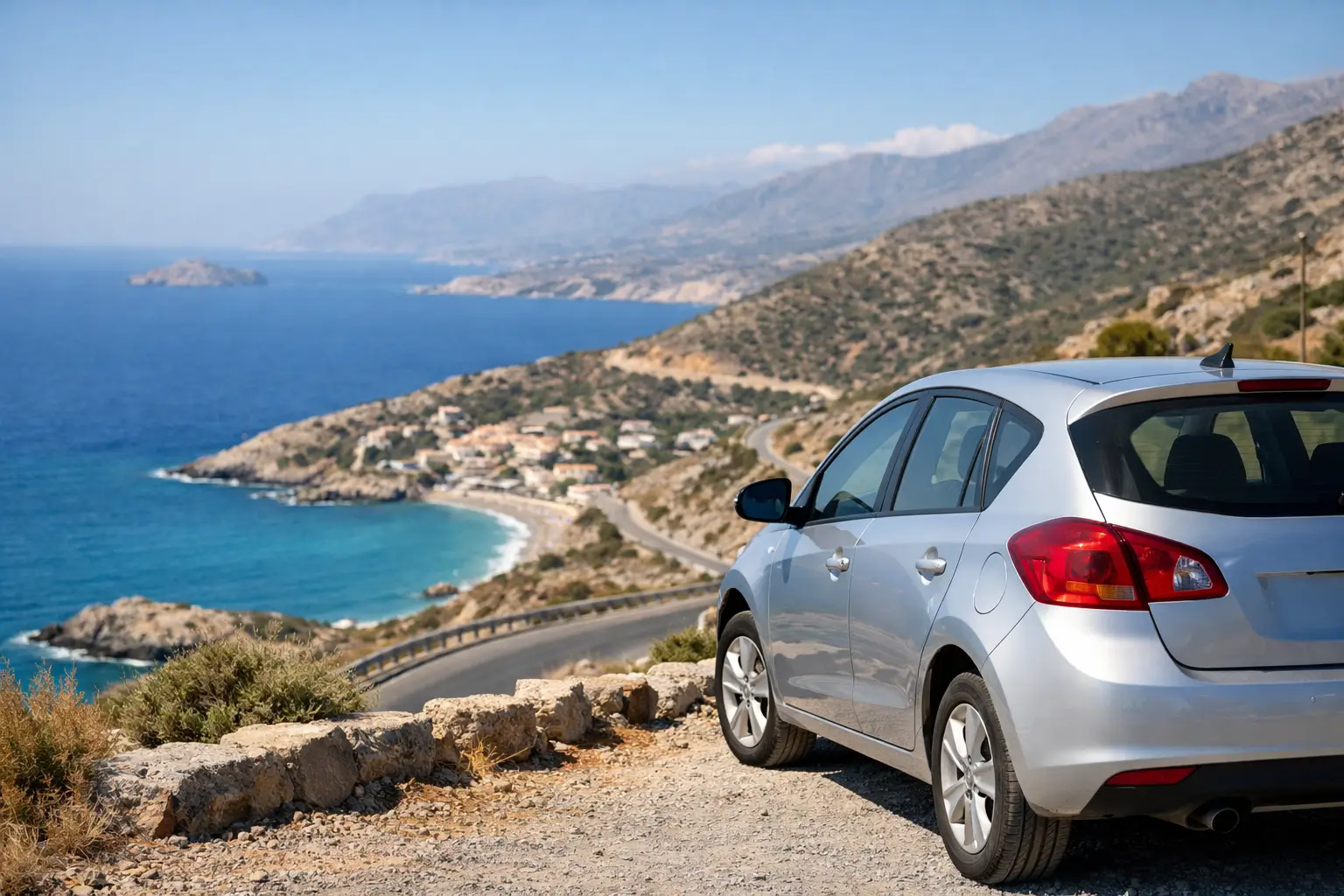


You feel the answer almost as soon as you land. Crete is not the sort of island where everything sits neatly around one harbour. It stretches wide, the beaches are scattered, the mountain villages sit inland, and the best tavernas are often nowhere near a bus stop. So, do I need a car in Crete? For many travellers, yes – but not always.
The right answer depends on how you like to spend your holiday. If your plan is to stay in one resort, walk to the beach, and use the hotel pool more than the road network, you may manage perfectly well without one. If, on the other hand, you want freedom to explore properly, a car changes the entire experience.
Table of Contents
Do I need a car in Crete for my type of trip?
Crete is large enough that location matters more here than on many other Greek islands. A couple staying in Elounda for a relaxed long weekend will have different transport needs from a family arriving in Heraklion and planning to see beaches, archaeological sites, and mountain towns over seven days.
If you are staying in a well-served area such as Heraklion town, Chania town, or a busy resort with restaurants and supermarkets close by, you can get around locally without too much effort. Taxis are available, and buses connect many of the main towns and popular spots. For short stays, that can be enough.
But once your plans include more than one beach, a day trip inland, or dinner somewhere outside your immediate area, public transport starts to shape your day for you. You are no longer deciding where to go based only on what you want to see, but on timetables, taxi availability, and how far you are willing to walk in the heat.
That is usually the point where a hire car stops feeling like a luxury and starts feeling practical.
When you probably do need a car in Crete
A car is especially useful if you are splitting your stay between different parts of the island, travelling with children, or arriving at an airport or port and wanting a simple onward journey. It also makes a clear difference if you value comfort and time.
Crete rewards independent exploring. One day you might want an early swim on the north coast, the next a drive through olive groves to a village lunch, and the next a late afternoon visit to a quieter beach. Those plans are easy with your own car and much harder without one.
Families often find this even more true. Carrying beach bags, pushchairs, snacks, and spare clothes onto buses is rarely anyone’s idea of a relaxed holiday. With a car, you keep your essentials with you, stop when needed, and avoid building the day around queues and transfers.
Groups also benefit. Once several people are sharing transport costs, hiring the right vehicle can become more efficient than repeated taxis. It is often more comfortable too, especially if you choose something suited to the route rather than simply taking whatever happens to be available.
When you may not need a car in Crete
There are trips where hiring a car is not essential. If you are staying in one place for just a few days, close to the beach and restaurants, and you are happy with a slower pace, you can comfortably go without.
This is often true for couples on a short resort stay. If your hotel is in walking distance of everything you need, the main benefit of a car may go unused. In that case, a pre-booked transfer from the airport and one or two taxi journeys could be the simpler option.
The same applies if you genuinely do not enjoy driving abroad. Crete’s roads are manageable, but some inland routes are winding, village streets can be narrow, and parking in popular areas takes patience in peak season. If driving is going to make you tense rather than give you freedom, it may not improve your trip.
There is no sense hiring a car for the sake of it. The best choice is the one that makes your holiday feel easier.
Public transport in Crete: good in places, limited in others
Crete’s bus network is useful, particularly between major towns and on established tourist routes. It can be a sensible choice for travellers with simple plans and flexible timing. Fares are generally reasonable, and for direct journeys it may suit you perfectly well.
The limitation is not that buses do not exist. It is that they are designed around main routes, not around every small beach, boutique hotel, or hillside village a visitor might want to reach. A journey that looks straightforward on a map can become slow once changes, waiting times, and return schedules are involved.
Taxis help fill the gaps, but they are best used selectively. For airport runs, evenings out, or one-off trips, they are convenient. For a full week of moving around different areas, they can become costly and restrictive.
That is why many visitors begin their trip thinking they will manage without a car, then realise after a day or two that they are seeing less of Crete than they hoped.
The real advantage of having a car in Crete
The biggest advantage is not simply transport. It is flexibility.
With a car, you can leave early for a popular beach before it gets busy, change plans if the wind shifts, stop at a viewpoint you did not know existed, or stay for dinner without worrying about the last bus back. You can travel at your own pace, which matters on an island where some of the best moments are the unplanned ones.
There is also a comfort factor that people often underestimate. Air conditioning between stops, space for luggage, no waiting in the sun, and the certainty of having your own route all add up quickly. What looks like a small convenience on paper can make the difference between an efficient, relaxed day and a tiring one.
For many travellers, this is why the question is less “do I need a car in Crete?” and more “how much do I want to get out of my time here?”
Choosing the right car matters as much as having one
Not every Crete itinerary needs the same vehicle. A compact car is often ideal for couples moving around towns and coastal roads, especially where parking is tighter. Families may prefer something with more luggage space and easier access for car seats, beach equipment, and shopping. If your plans include longer distances or hillier drives, an SUV can bring extra comfort.
This is where service quality matters. A holiday is smoother when you can book the category – or even the exact vehicle – that actually suits your trip, rather than adapting on arrival. Reliable delivery at the airport, port, hotel, or resort also saves time and avoids the usual rental counter friction.
For visitors who want a more polished experience, that certainty is valuable. A local provider such as Autochoice focuses on exactly that sort of convenience, with modern vehicles, flexible collection points, and straightforward service across Crete.
A few practical trade-offs to consider
Hiring a car gives you freedom, but it does come with responsibilities. You will need to think about parking, fuel, and basic route planning. In high season, busy beaches and popular old towns can be harder to park near, especially later in the day.
There is also the question of how often you will actually use the car. If it will spend most of the week parked outside the hotel, then the value is limited. If you will use it from the moment you arrive until the day you leave, the convenience becomes far clearer.
One useful middle ground is to hire a car for part of your stay rather than all of it. Some travellers prefer a few car-free days in a resort, followed by two or three days of exploring. That can work well if your itinerary is mixed.
So, do I need a car in Crete?
If your holiday is centred on one town or resort and you are happy to keep things simple, probably not. If you want to experience more of the island with comfort, flexibility, and less dependence on timetables, then yes, a car is usually the better choice.
Crete is generous with places worth seeing, but they are spread out. That is the key point. The island gives more to travellers who can move easily between coast, city, and countryside.
The best decision is the one that matches the kind of trip you actually want. If you picture yourself staying local, keep it easy. If you picture hidden coves, mountain roads, village lunches, and the freedom to change course whenever the day looks promising, a car will feel less like an extra and more like part of the holiday itself.